September 7-9, 2024 Ngorongoro Tanzania, Africa

After a lovely farewell from the staff at Chem Chem we made our way back to the entrance of the gate keeping our eyes peeled for any unexpected wildlife sightings; we did see more impala and as I write this I am sure they a paying little or no attention to the comings and goings of these strange humans.  When I leave a place I reflect on the silence brought about by our absence and the freedom that comes with that thought.  

We were met at the gate of the concession by our guides, Emanuel and Logi, from the Entamanu Safari Lodge.  Emanuel was an older gentleman having been a guide in this area for over 30 years and in my view it felt as if he was more of a wise sage accompanying us on our journey.  Logi was his apprentice whom he had known for a long time and was set to take over from Emanuel when he retired – which he hoped was soon; Bob and I could sympathize with his desires. The guides and drivers work very long hours and seem to spend most of their time on rough roads; they must adapt to this sort of thing that would make the rest of us go somewhat insane.  Yet they are always excited about the wildlife and showing us their treasures, especially the hidden ones.  

We spent most of the drive on a nicely paved highway that apparently takes you all the way to Egypt which was an interesting thought.  We then veered through more Masai land herding their cows and goats that for me was an interesting comparative study to the Native Americans who also managed to thrive in a place that seemed rather devoid of any lush accompaniments, but that consideration alone discriminates against a people who live in relative satisfaction with their lives – so who is really the more privileged?  As I sat in the comfort of the land rover, rolling by in relative ease, internalizing, much like I did in Nairobi, especially as we drove by the interminable Kibera slums (over 2 million people), at how much of the world does not experience my immunity to that way of life. 

Emanuel insisted that Entamanu wasn’t Chem Chem and Bob and I had no issue since we weren’t subscribers to Architectural Digest and had expectations of something a bit more rustic.  Emanuel said there are other “fancy people” lodges in the vicinity but not at the elevation of this one.  We didn’t come to Africa to be pampered, you can get that at any resort along the Mediterranean, though we did start growing accustomed to the outstanding service levels we were to meet along our trek.  

After a few hours we started climbing into the highlands with its deep red soil and lush vegetation.  The air reminded me of the Pacific Northwest for some reason though the landscape was set in a more jungle-like atmosphere much like Hawaii.  The elevation and positioning near the equator creates a rich elixir for the senses with a fascination of vines and thick undergrowth.  We passed through one of the local towns with its usual madness of tuk tuks, motorcycles and donkeys.  It’s a fusion of the new and the old, with the old ways being somewhat more practical when modern civilization fails you.  Though one does wonder how the art of carrying the sofa on the back of a motorcycle is cultivated.  

Soon we arrived at the gate to the crater.  The Ngorongoro Crater is a UNESCO World Heritage Site and the largest unbroken caldera in the world.  The road that leads to the crater is not paved and the larger potholes are filled only every few months to no avail…as if by design; it was very busy so we had a lot of bumps, curves, exhaust, dust and what appeared to be near misses with other vehicles, but that was only true in the over-civilized imagination.  

I discovered that there are two classifications of dust on the safari circuit: Civilized dust that occurs on structured roads that is mixed with exhaust and sets your sinuses on fire and the uncivilized kind that blows through you as you rough-road through a savannah, seeping into your cells so you can become one with the earth, a visit back to a forgotten self. The latter is the kind of “dust” I hope to visit in my dreams. 

After what seemed like an eternity, (an exaggeration on about 45 minutes) we came across an orderly battlement of vehicles worthy of an outdoor cinema; this was a front row seat into the caldera from the viewpoint of a bird.  Like the Grand Canyon, you momentarily forget all your senses as you peer through the gates of heaven trying to reconcile that such a magnificent vista really exists.  Here Mama Africa cupped her hands and cried tears of joy as she gave birth, flooding the plains with a deluge of creation.  

We moved further up to our lunch venue near facilities (many times there are attendants who come and clean after the “flush” with a hose, because the water pressure may be in question) that apparently is a common meeting ground for tour groups.  I have found that many of the general tourist-area toilets (very true for the bush airports) are wanting for some reason – considering the volume of visitors.  The lodge facilities are typically great if not outstanding.  

We settled on stumps and fold-out chairs, mostly to avoid the ants at the picnic tables, and ate what had been given us from Chem Chem, sharing much of it with our guides as we were at this point already being overfed; such is the tradition in Africa.  

Unfortunately, Emanuel’s sandwich was torn from his hand by a passing eagle😫 On the bright side it could have been a seagull or a crow, but he was afforded a more prestigious grab.

We then meandered through the equatorial jungle that broke into highland grasslands, passing through more Masai country with their bomas, and as we gained elevation we could see the distant plains of the Serengeti and its earthly haze.  We turned off to the road leading to the Entamanu Lodge – the highest one in the Ngorongoro Highlands and in its own unique location on the rim; this location also affords you access to the crater floor before just about everyone else. 

https://www.nomad-tanzania.com/camps/northern-tanzania/ngorongoro-crater/entamanu

We arrived and after our briefing, decided to go on a walk around the highlands to stretch our legs.  We were accompanied by a ranger complete with a rifle and a Masai with a spear and a walking stick that I decided to use on the downhill slope.  It was a beautiful and clear day through forest and grasslands, there were elephant and antelope sightings though we didn’t encounter any, but we were graced by the giraffes who poked their heads above the acacia trees; referred to fondly by the Masai as “bush towers.”  We learned about the trees and medicinal properties of many of the plants.  We encountered the ubiquitous cattle drive, with the soothing tinkling of bells and momentarily became herders ourselves.  We managed to get about an hour of elevation cardio in before we went to our room and freshened up for dinner.  

We had our sundowner with others in the lodge, set near a lovely fire. We ran into Americans who would be staying at the Serengeti Safari Lodge so we would have a somewhat shared experience moving forward.  

At this height, It doesn’t take long for it to get cold and windy and after a nice supper we were escorted to our room (a practice we would find at every lodge) with a nice gas fireplace – that was truly welcome!  Our room had a bit of a Scandinavian vibe to it; very understated with cow skins and rugs so you could settle in for an evening, protected against the elements. 

During the night, the wind rattled things a bit and we were awoken at 5:00 with a tray of superb coffee that was placed in a kiosk built into the wall – much like a stationary dumbwaiter, so we can easily retrieve it without too much disturbance, and also letting the cold in.  We huddled in bed until the fire got us warm enough to get dressed.  As we stepped outside, bundled in almost every layer we had thought to bring, the wind mixed with the fog made for a very atmospheric, almost jack-the-ripper start to the day. We were escorted to the land rover, complete with blankets and hot water bottles.  We retraced our way to the entrance that lead to the crater floor; we wound down this portion of the road that has been, thankfully, repaved into cobblestone.  The mist started to lift and the sun eventually parted, revealing the treasures below.  

At the threshold of the cauldron, a rhino was spotted in the distance but it was too far for my camera lense, but we watched as he sauntered across the grasslands in solitude.  There were currently very few other vehicles in the vicinity.  

Our first stop was a fresh lion kill which at the time was a very novel event for us.  We were glad we were early birds because in about an hour nearly 20 other vehicles started to pile up for a look, even though only five vehicles are technically allowed at a time.  Many had up to six people packed in trying to get selfies; and fortunately for us being early gave us the best vantage point and the lions would be fast asleep by the time many of the other sightseers arrived. 

The morning meal with the lion family was a sight to behold, giving us Africa in all her savage glory; blood soaked faces and mama licking her cub clean.  The tearing of the flesh and breaking of bones is an auditory and elemental experience. 

We also had a chance to study two magnificent male lions before they too passed out for a day-long siesta.  Emanuel called one of them “Mufasa” and they were certainly stunning specimens (I sometimes wonder if he isn’t also referring to himself!).  There had been two kills as the remains of a wildebeest were not far away, on the other side of the road.  When you observe the family, even though their bellies appear horrendously full, they keep eating as they sometimes don’t know when their next meal will be. 

Mufasa

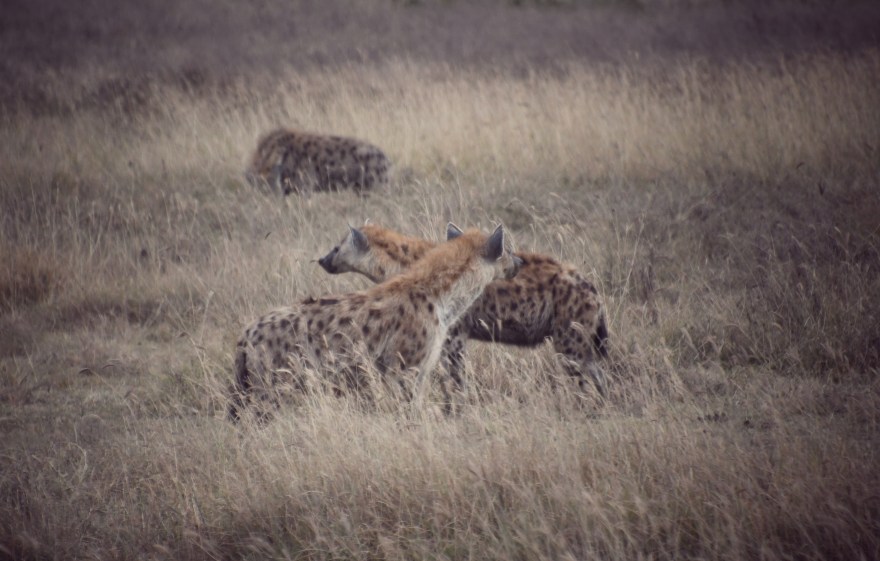
There was a troupe of hyenas and circling vultures nearby, but they hadn’t ventured too far as the two male lions were not far away, and I guess that was more than the scavengers could bear for now.  
As we were by a lake, we saw plenty of bird life including flamingos.  The area was rife with hippos who would move occasionally but were otherwise content to be enormous slugs along the shoreline.  

We managed to squeeze past the increasing number of vehicles, some that were blocking our progress, and at the point were happy to be extricated from the fray, and proceeded through the vast ecosystem seeing some stunning bird life – the Crowned Crane topped the list and proliferated everywhere it seemed. 
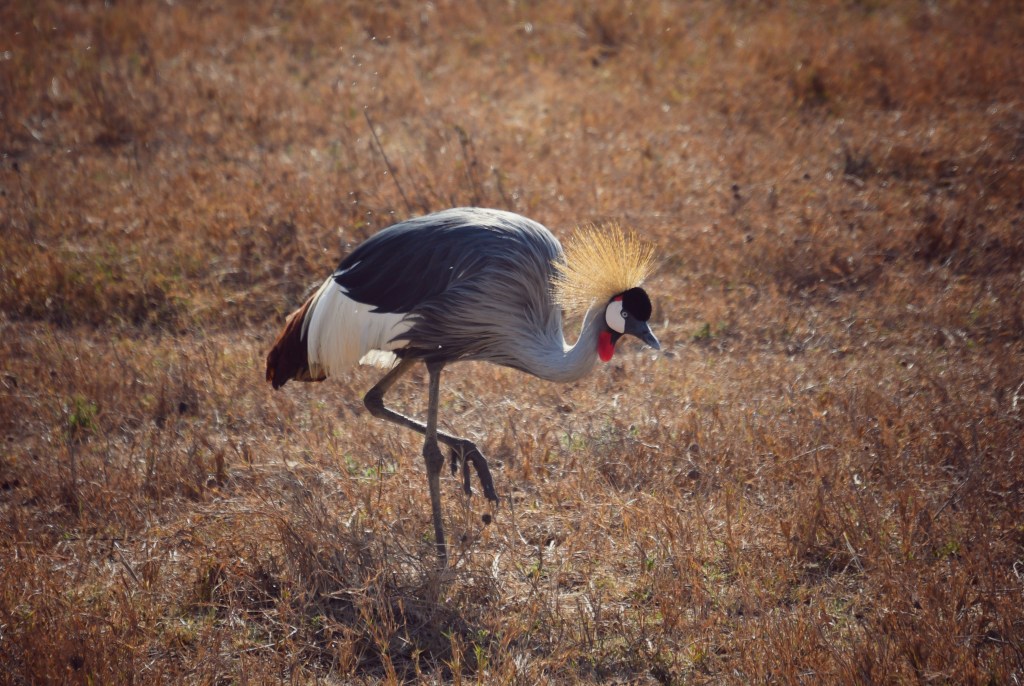
Gray Crowned Crane

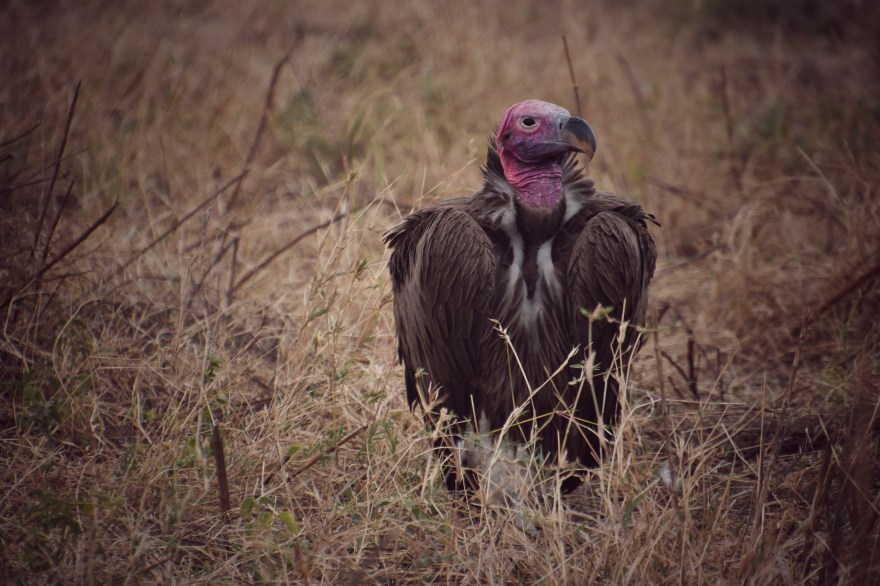
We saw Ostrich couples and studied the vultures that looked very similar to condors. Many people think they are ugly, but like the hyena, they are very unique and necessary to the savannah.  I find them quite fascinating.  
We then moved onto more hippos including the rare experience of a mating couple  🫣. We then stopped for breakfast, which is basically an area reserved for tourists with decent bathrooms.  It was set overlooking a lake with an accompanying marsh with elephants, more birds and of course hippos; we witnessed two sparring which was a treat and of course you don’t venture too close to that sort of spectacle (one gentleman was getting too close and the guides started to freak out). 

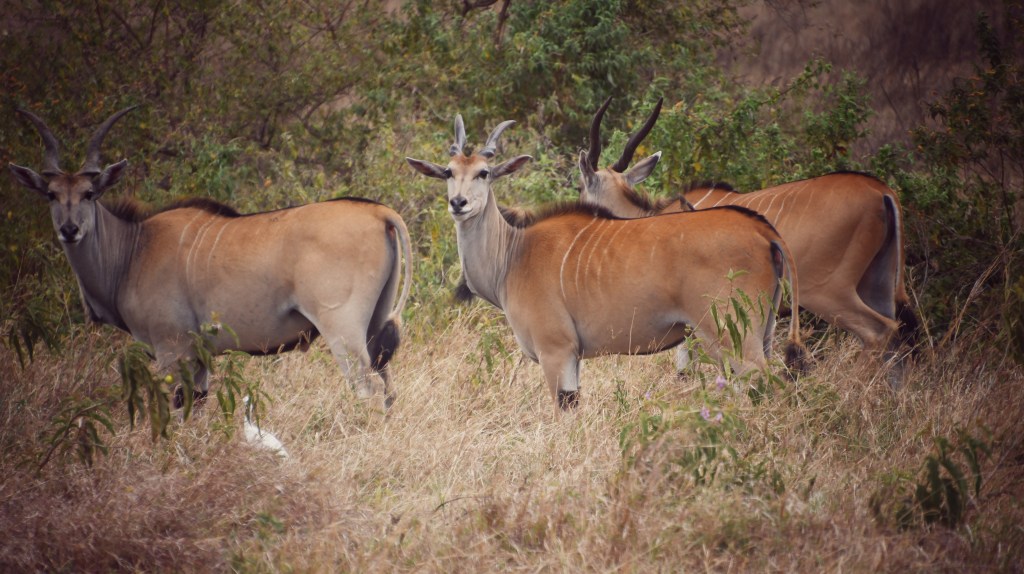
As we ate and chased away the neon blue starlings on the hunt for breakfast bits… but this time the eagles were absent and we managed a meal in relative peace. The sun was breaking through the cloud layer making for ethereal backdrops with the game seemingly small against the dramatic escarpment. We even encountered a small wildebeest migration crossing the road; a prelude to what we hoped we would experience in the Serengeti.  The crater is an astounding area within its own microcosm, protected so the inhabitants can live out their daily lives in relative peace (save for us tourists but rangers can come and break up the “party” if the drivers get too aggressive).

We stopped off on a knoll overlooking the grasslands, a gentle wind ushered in a peaceful vista, filling my lungs to capacity.  I can imagine at night, even when the predators are restless, the peace here is palpable and it’s when the cauldron truly comes to life.  When one thinks of a cauldron it usually means fire, but here, this is a cauldron of life.  

We made our way back to the rim and ended the day with a highland bush walk, again with a ranger and a Masai guide that took us through a herd of giraffes who poked their heads above the canopy – they stopped and watched as we walked past.  We headed for our sundowner spot, all set up with an open bar and a lovely view, across the landscapes of the Ngorongoro – the sky becoming a picturesque magenta. 

We then began to hear the chants as dancers from the local Masai village filed in, in all their respective glory; it was certainly one of the highlights of the day.  

As the dancing faded we could once again hear the cow bells from the nearby herds, a background symphony that earned this area its name:  Ngorongoro echoes the tune of cow bells, as demonstrated by a song rolling off the tongue of our Masai guide.  There is no end to the charm of this place.  

The next morning our guides took us back down the road-from-hell and it seemed like even more tourists were winding their way back up.  After about 45 minutes we reached the gate and the accompanying mayhem.  It certainly makes for great people watching. I’m torn by the need for tourism to fund the people of Tanzania, and the abuses that accompany this sort of progress.  

Back on smooth roads again we were driven to the Manyara airstrip for our next stop, the Serengeti and the Great Migration. The strip is small and we were flying in a cessna so it was going to be cozy to say the least.  We bid Emanuel and Logi a fond farewell – we felt so blessed to have had a private vehicle with two excellent guides; they did an incredible job of showing us the sights and skirting any potential hoards.   We soon squeezed our way into the cabin. The she-captain tells you to fasten your seat belts but the gentleman across from us couldn’t get his belt to work so he tied it around his waist #thisisafrica.  As we ascended, the crater opened up below us, giving us a parting panorama as the massive cauldron and its inhabitants slid into the distance.  

The Ngorongoro

September 2-7, 2024 Nairobi to Lake Manyara Africa

We checked our bags in Toulouse thinking we would see them in Amsterdam as we were staying overnight to visit a friend – but KLM, being as efficient as they are, checked them through to Nairobi.  I was hoping for my toothbrush and comb then I realized as we walked through the airport it was as though the universe had beat back time to 1993 when my only possessions were my camera and a few pieces of clothing.  Outside of feeling hungover even though I haven’t had anything to drink, sore shoulders and a questionable knee, I could be back in the Amazon – feeling more weighed down by the humidity than my luggage.  

When I watch movies about the western frontier, I’m thinking those folks haven’t had a change of clothing or a good wash up in a long time.  It’s always good to keep things in perspective. 

The small glimpse of Amsterdam I witnessed in the fading light was an impressive collection of architecture with contemporary structures competing with one another. The bicycle culture races by with many of them piled up on or near the racks, holding after dinner conversations I suppose, until the next rider appears to disrupt the party.  

The next morning we caught up with one of our friends who had moved to Holland from the states and we had a long breakfast discussing our respective immigration challenges and reminiscing about the good old times.  It was so lovely to catch up on a walk around the canals.  We then embarked on our 8 hour flight to Nairobi that all-in-all turned out to be uneventful.  And…the anticipated ground crew strike had been averted for now so we held out hope that our luggage would follow us unhindered to Nairobi.  

When we arrived later in the evening, we were met with red carpet service by two charming Kenyan gals from the travel agent, who got us through our visa processing and customs in an obscenely short amount of time.  We were then whisked away to the Fairview Hotel, a lovely British Colonial-style resort hotel, shrouded in security to the extent they x-rayed our bags before entering the hotel.  This we figured was to prevent any terrorist attacks on the hotels – the same thing goes for the malls.  

Though it’s always tiring going on long-haul flights we at least didn’t have to grapple with jet-lag. 

The next day we visited the Blixen Museum, the former home of Baroness Karen Blixen, the author of Out of Africa; her influence cuts an impressive swath through this area known as the Karen District. She introduced coffee to Kenya and on her plantation grew Arabica beans.  I knew she grew coffee but did not know that she grew that brand.  I will have a new appreciation when I go shopping for coffee from now on!  

The tour was much more comprehensive than the last time I was there 34 years ago.  We were given a thorough history and tour; as we walked the path between the kitchen and the main house the scent of jasmine wove its way through our senses – much like her writing.  

Once in the house we entered her study where her typewriter, the cuckoo clock, the gramophone Denys Finch-Hatton had given her and also a large collection of his books donated by his family; a fitting addition to the house considering their equal obsession with literature. 

In the room was also a french screen with many different pictures that served as a foil for her stories; she would have a guest pick one of the scenes and she would spin a tale, entertaining them for hours in front of the fireplace.  

The house is not large, not like the one in the movie, and it is decorated with animal skins and other African artifacts including her lovely paintings; she had quite the talent it turns out.  The largest room was the dining room, laid out as if she was expecting us for dinner.  

We then walked across the vast lawn to the path that led to the coffee mill; on the way an eagle landed, a rather impressive specimen that had no reason to visit as there was nothing of interest in the lawn itself.  He sat for a few minutes, cocking his head like they do while watching us.  He walked around for a few minutes and did not leave, even as we entered the forest.  It was quite intriguing to encounter one of the Eagles of the Ngong that the baroness speaks so fondly of in her writings.

Her tale ends in devastating sadness as the plantation went bust and shortly before she had to leave to go back to Denmark, Denys was killed in a plane crash.  In her autobiography it was conveyed that she and Denys had ended their relationship as being the wild thing that he was, and though they had been soulmates for years, he still would not commit to her.  She considered herself “dead” to him then and in the end, his untimely demise was the last cruel hand that fate dealt her as he was now dead to her.

Their story took us over to the Ngong Hills where, after driving the chaos of Nairobi and washer board roads, we came to an obscure field edged by a hedgerow with a phone number on corrugated metal on where to call for entry. 

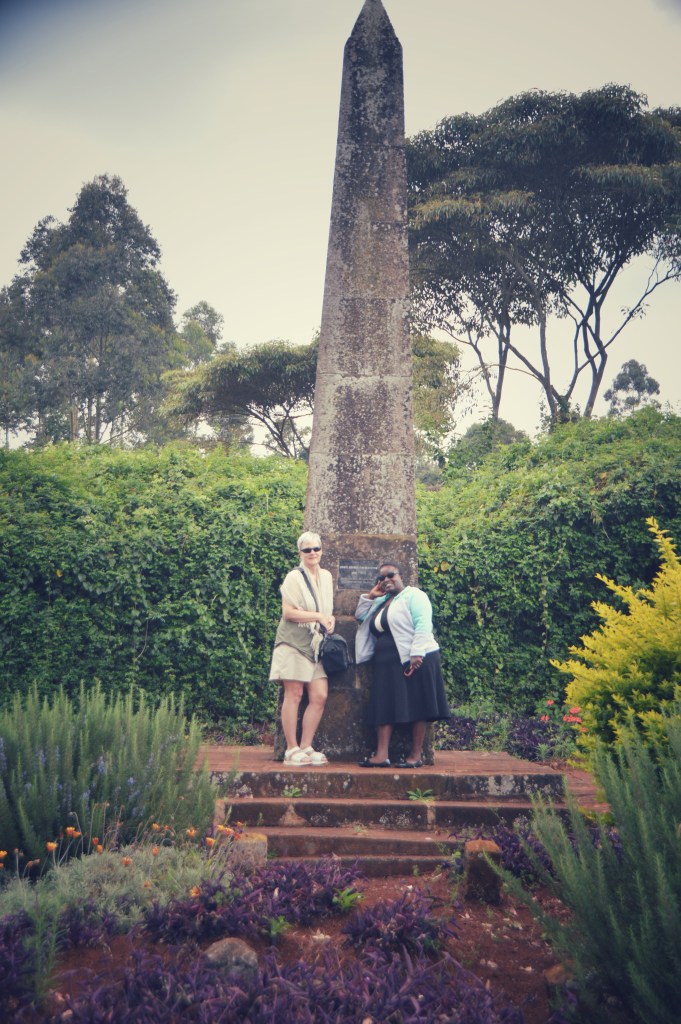
We were met by Damares who let us into Denys’s gravesite; equally manicured and appropriately surrounded by wild bush.  Damares is the great grand daughter of Kamante, Karen’s houseboy.  Karen and Denys would “escape” to this place that was once a grassy knoll in the hills with a view of the plains.  Back then it was a day-long trek to get to the site and back in the 1920’s it was pretty easy to get lost up there.  In this place they would cocoon, as lovers do, and it was during their romance that he said he wanted to be buried there.  Karen had the same idea but it never came to fruition.  Denys was killed when he crashed his Gypsy Moth and it burst into flames, Karen, his friends and colleagues took his coffin via oxcart all the way up to this spot.  When he was buried it was only marked with four stones.  Later, his family erected the obelisk, and on his epitaph a quote of the rhyme of the Ancient Mariner.  

Spending time with Damares – the great granddaughter of Kamante

The rocks were then replaced with rounded, sculptured stones.  Others were also near the site, but were a bit overgrown now and Damares said those were probably placed there so that Karen could be buried next to Denys.  

In the 1920’s the Ngong Hills were home to big game including lions.  Shortly after Karen left, a lion and lioness visited Denys’s grave – as fantastical as it sounds, as we thought it was just something manufactured by Hollywood for the movie, Damares assured us the story was true as it was Kamante, who visit from time to time, who had witnessed them.  

We took in the atmosphere of the grave and its surroundings, imagining the grassy knoll and the view of the grave Karen could see from her house.  

Their story was one of the great romances to come out of that era and it is as magical as the writing the earned Karen Blixen, aka Isak Denisen her stature as one of the foremost story tellers of the 20th century. 

It seems odd that someone as legendary as Denys Finch-Hatton, who even has a bridge named after him at Eton, is buried in a rarely visited grave in the Ngong Hills – or maybe not – this is where he spent the most precious moments with the loves of his life: Karen and the wilds of Africa.

After winding our way back through the Ngong Hills and on down to the main streets of Nairobi we turned off into a secluded resort area. We ended the day with a lovely meal of “wet” chicken cooked in earthy spices, green mashed potatoes (green because they use pumpkin leaf) and kale.  Our Kikuyu guide had given us an outstanding day roaming around the influences and history of an enigmatic storyteller.  

The following day we wanted to get some shopping in as we would not have a chance on the safari circuit.  Our guide from the Fairview, Bernard, took us to the Kobe Tough (Kobe means turtle in Swahili…to be interpreted as these women having a touch shell), a bead shop that was developed to employ impoverished women. We were greeted with song and impressed with this whole enterprise to help women of lesser means find employment.  I think my favorite purchase on this safari is the Masai Apple Watch band that has now become a conversation piece. It’s a lovely beaded piece that I hope will last for a very long time.  

We packed up our purchases and left them with the front desk of the Fairview so we could collect them before our final flight home.

The next day we flew into Arusha, getting through the visa process with relative ease; it pays to have the forms filled out and your cash ready.

We were escorted to the lovely Arusha coffee lodge where we overnighted and headed out the next morning to our first stop on the safari circuit.

After an uneventful two hour drive from Arusha to Lake Manyara, we arrived at the stunning Chem Chem lodge where we were greeted by the staff with those huge African smiles including three magnificent Masai Warriors – a vision that reduced me to tears. Chem Chem is a private concession in the Tarangire and Manyara Lake reserve areas that provides an upscale safari experience while funding the preservation of the local wildlife corridor.  

It’s a tent lodge though is a permanent installation set upon stone and boardwalks that lead you to the main area.  It’s ranked as one of the top African lodges and looks like a feature out of Architectural Digest.  It’s very spread out, in elegant repose, with the main area overlooking a watering hole, or oasis as the palm trees make for a tropical effect, and you can sit and watch the wildlife come and go; they call it “bush tv.”   The area is thick with baboons, monkeys and impala; they peak out from under the boardwalk at you, completely indifferent to your presence.  

The area is hot and dry, yet the humidity is low making it comfortable.  Inside our tent we had all the comforts of home including a shower in the room and one right outside (walled off in stone), where you can wash up “in the wild” though the monkeys really take no notice.  And we had a full coffee station with an espresso machine!! There is glamping and then there is Chem Chem.  

After freshening up, Nenga, our driver, soon whisked us out on safari where we were blessed with elephants galore and Bob was able to take a ride in the “safari seat” up close and personal to a curious pachyderm. 

Close but not too close!

A herd then made their way to the local watering hole complete with a hide where we could watch in relative safety:  Nenga was really excited as this event is a hit or miss. 

He then got a call that a pride of lions had been spotted and we soon found them laying across the road, finishing off a day’s nap and getting ready for their evening haunts. 

Not much going on here but still…anything could happen

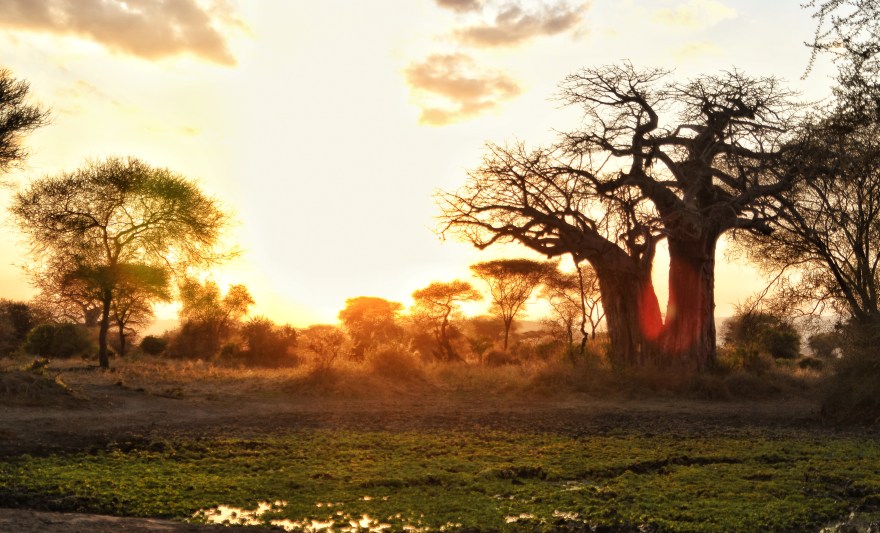
We had our first “sundowner”  – basically drinks in the bush watching the sunset against the super exotic baobab trees with giraffes wandering by making the evening quite mesmerizing.  Suffice it to say, we immediately went into sensory overload. 

Our first African sunset

We got back for dinner as the light grew dim and were escorted to a private setting with a backdrop of lanterns recessed into a massive termite hill, the table was lovingly strewn with orchid petals; they somehow knew our anniversary was coming up and had set aside a lovely dinner with champagne!  

Happy and exhausted we settled into tent, shrouded in mosquito netting and fell asleep to the night sounds of the bush. 

During the night we were woken abruptly by the shrieking of baboons and monkeys.  This racket went on for a good hour and half and while we found it disconcerting, it did occur to us that there must have been a predator nearby.  The unbroken rule at all safari camps is no one goes out after dark without an escort and this first night confirmed why that was.  Soon we could hear the lion in the distance as he walked his territory.  

After a fitful night sleep we awoke to impala grazing right outside our tent, and then soon a herd of zebra wandered by.  I sat and let my mind go until we were beckoned to our morning jaunt.

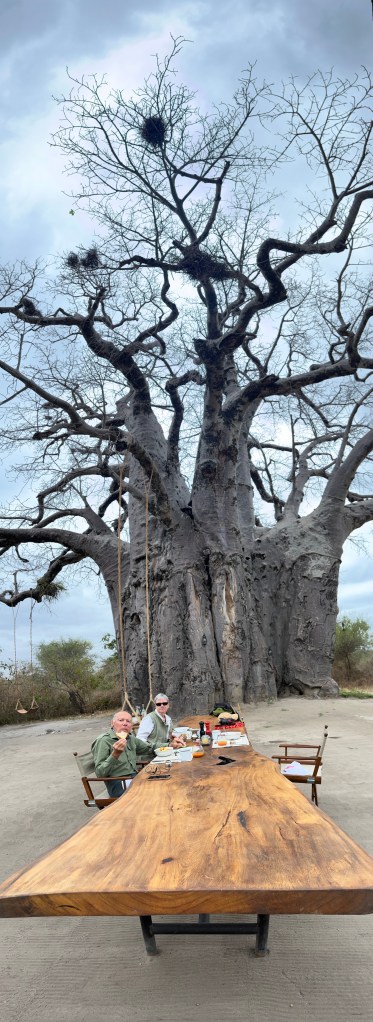
We stretched our legs on a bush walk with Nenga alongside a Masai Warrior, discovering different aspects of the fauna and the Masai way of life.  The walk ended in a bush breakfast that could not be equaled:  Set under a baobab tree on a huge live-edge table was our feast, elegant and seemingly spare compared to the table we were being served on.  There were staff who had prepared breakfast over an open fire including a steaming hot water pot where they prepared coffee at the table.  Even the toilet facilities were crafted in a thatched hut, rustic yet practical with running water  – it was hard to believe we were in the middle of a game park.  

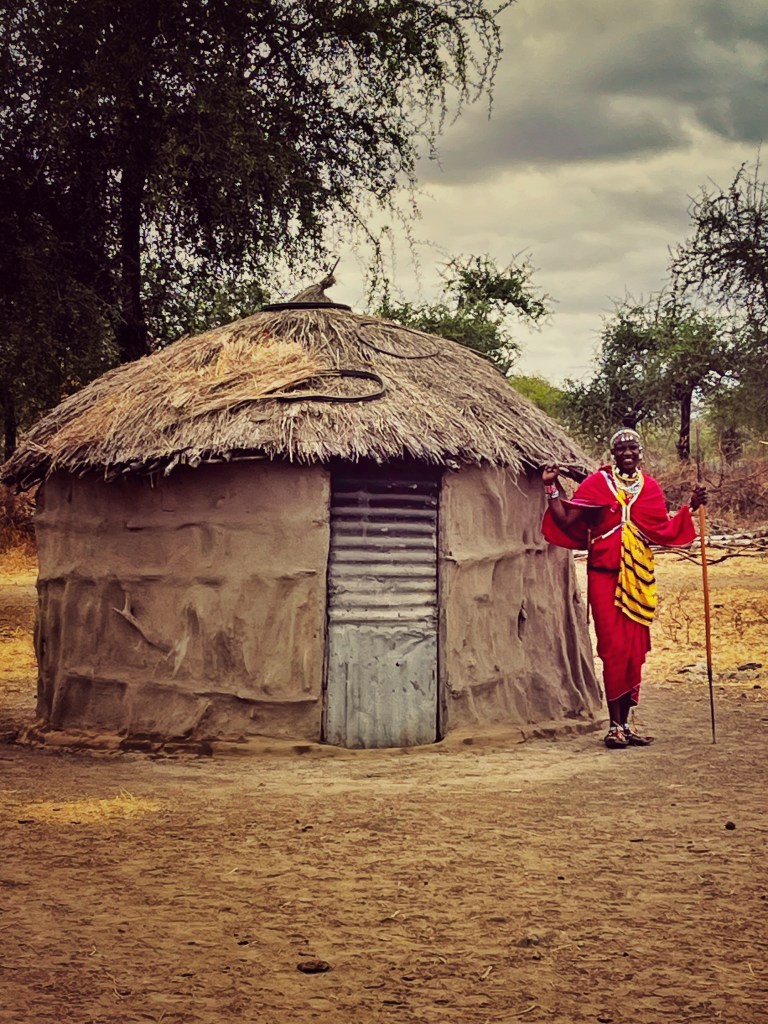
After recovering from this culinary event, we retreated to our landrover, and ventured to one of the local villages where we met a Masai chief and his four wives.  We learned more about the structure of the Masai village and culture, and challenges the chief faced with running this sizeable operation, most conflicts related to animals, property rights and marriages.  

His main residence was small but well structured out of timber, mud, dung and urine that also doubled as an insect repellent.  The spare rooms were segregated with the wife-of-the-moment in one room and the children residing in the other.  After much discussion, the chief wanted to bless us for our long marriage and though we felt it was more of a touristy gesture, we obliged though were certainly out of sorts being white people in this setting.  

Back at the lodge we had lunch in one of the towers that gave us a lovely view of the lake and where we could watch the game come and go and relax for a few moments. #bushtv 

We rested for just a little while until we headed out on the afternoon safari where we found a pride of lions tucked into the high grass; it’s a bit disconcerting if you think of Masai walking around minding their business and then you run into a pride – they are so difficult to see and many are in sleeping under the bushes.  Nenga’s sharp eyes somehow sussed them out and we spent the remainder of the drive watching as they started to wake, literally watching the papa lion fade into the sunset.  

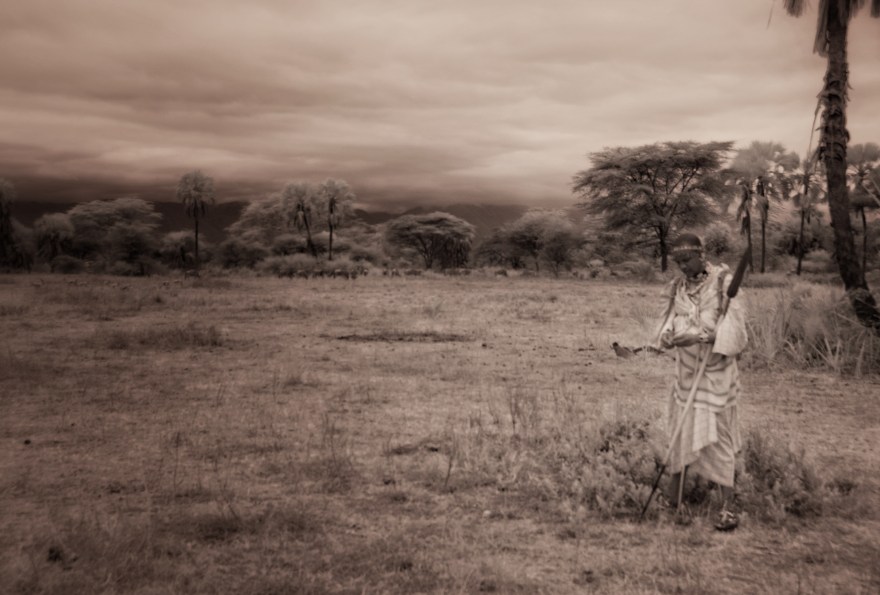
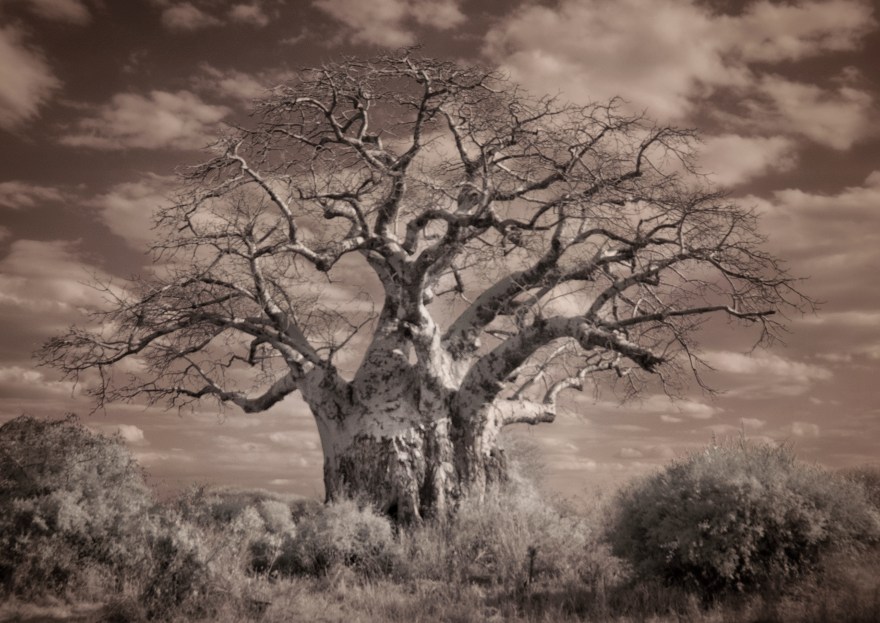
This ended our first stop on the Tanzanian circuit, we were set to go to the Ngorogoro Crater in the morning. I’ve included some of my infrared work while I was out and about; I was especially taken with the baobab trees❤️

Masai Warrior on bush walk
Baobab Tree
Masai Village