This is the fourth time we’ve been to Italy and the convenience of being so close now, it never gets old.
It was a pretty uneventful puddle jump from Toulouse to Naples, but upon arrival we couldn’t find the rental car agency we had booked through the airline. We went to the usual rental car hub to no avail. We then called and found out the agency was about a mile away and they had no shuttle. We had never encountered this scenario before despite being well-traveled. She offered to pick us up at the bus station though we had no idea where that was and wouldn’t pick us up where we were due to airport regulations, so we wound up hauling our luggage through a questionable area to where they were stationed. Then she wouldn’t accept Bob’s interim French license (perfectly valid) or my French license 😳, and proceeded to add on several hundred euros of deposits just in case of damage or theft. She said his American driver’s license wasn’t valid in Italy as well (note to Americans: if you wish to drive in Italy you need to get an international driver’s license or IDL, you risk being fined if pulled over). Turns out she was an independent operator and why RyanAir contracted with her was a bit mystifying. In the future, we will go with the standard car agencies.
We then got a beat-up Ford Fiesta which added to the goat-rodeo though that turned out to not be an issue; we found that many of the cars in Italy are damaged in some way, theft is very high, so even if we did some minor damage she probably wouldn’t have even noticed. The dented cars pay a certain homage to the italian driving habits; while we complain about the speed-demons on the country roads of France, it is nothing compared to the out-and-out disregard that is inbred throughout the motorways of Italy. The scooter drivers do really live on the edge but it is some of the best transportation around when consider the driving environment.
After the somewhat stressful and mystifying rental car experience, we found our way to the BNB, Domus Agricola Corallina tucked up in the foothills of Toro del Greco (just outside of mainstream Naples) and just below Mt. Vesuvius. It is a very rustic complex of villas where the proprietor of a terraced farm produces saffron, olive oil, and various kinds of fruits. The views are lovely, overlooking the shimmering sea with the Island of d’Ischia in the distance. And it was quiet, away from any hub where the rabid drivers of Italy prevailed.
There were some interesting artifacts strewn around the property and as we were a bit off-season, we were the only ones there (really one of my favorite things as then you get to enjoy some peace and quiet).
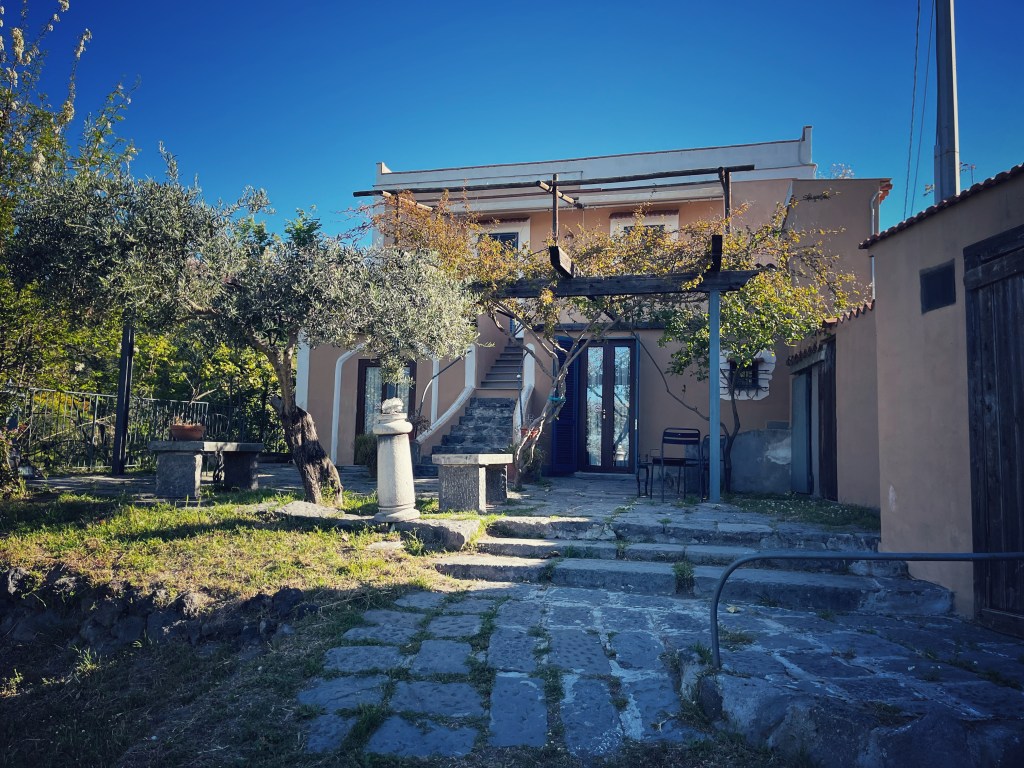
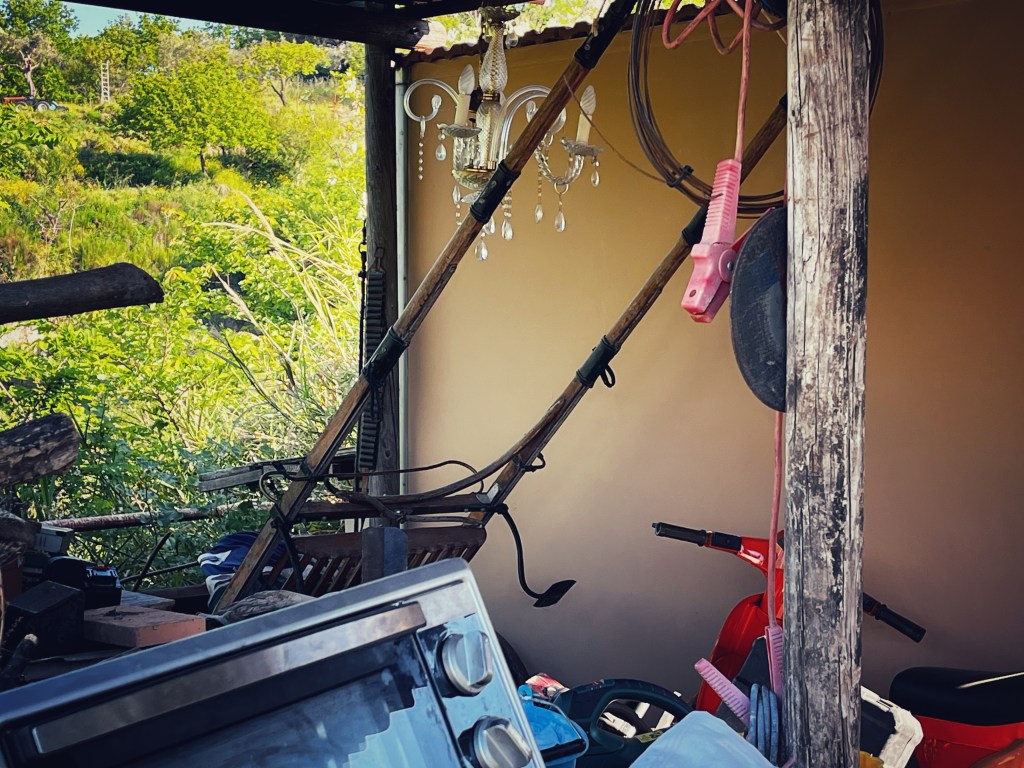
Interesting artifacts around Domus Agricola Corallina
Interesting that we were just below the famous (infamous) Mt. Vesuvius; for us folks in the Pacific Northwest with our impressive Cascade Range and the remnants of Mt. St Helens, whose cauldron sends up occasional puffs and swallows us whole with what remains of her cataclysmic explosion, we have to remind ourselves of what happened 2000 years ago that devastated Herculaneum and Pompeii. In the end, I didn’t pay Mt. Vesuvius much-mind, knowing that there is history, more than landscape, here, for me anyway.
The following day, not wanting to battle the traffic, we took the train from Toro del Greco to Naples which turned out to be smooth aside from finding parking around the train station – such a dearth of places at the station itself, but we managed to squeeze into a parking space about ¼ of a mile away so that worked out OK.
Once we arrived in the (Historic Quarter of Naples), it was easy walking, but you have to be situationally aware as one must expect the scooters, and sometimes cars, will shamelessly squeeze through streets that are teaming with tourists. During lunchtime, the crowds ebbed and flowed and we walked through some of the laundry-laden back streets to avoid too much traffic and people. There is a lot of trust with the hanging laundry as some of it is hung so low you could steal it. And they aren’t shy about showing off their underwear either.
In the historic center of old Naples lies the Via dei Tribulani, an avenue that is much like a huge block party with cafes and pizzerias stringing from one end of the boulevard to the other – with the occasional tour group that somehow squeezes through chaos. It was crowded despite being early in the tourist season – and fortunately we had good weather. I think the shoulder season is, now, what the high season used to be. I can’t even imagine being here during the summer season.
The pizza was the best though – Naples is where pizza originated, and they live up to the hype. I had the Margarita pizza and the density of the tomato sauce with a thin crust, and a simple topping of mozzarella and basil – just fantastic.
We then ventured down the frantic, messy, and crowded Via San Gregorio Armeno. It was interesting ,but rife with religious artifacts and the shops selling all the same stuff, but for anyone who is there it is an interesting touristy distraction.
I wouldn’t necessarily go to Naples for shopping (the old town historic area) but for the sites and the people watching and…of course the pizza! There are plenty of architectural marvels to be had around Naples, but we are a bit spoiled living in Europe and weren’t in a rush to see another grand cathedral, building or piazza so ventured back to the quietude of our BNB.
The following day we arrived in Pompeii – the stuff of legends and… the most touristed site in all of Italy.
It was windy and somewhat cold that morning as we meandered through the ruins. We had “skip-the-line tickets” though the signs were not clearly marked at the train station where I was to retrieve the hard copies along with the guide book. Fortunately they had “handlers” standing looking for people, like me, who looked confused and lost and she pointed me in the right direction.
Bob parked the car which was conveniently located in a parking area not far up the road. Once at the gate, we were directed to some tills where people were buying tickets even though we were in the “skip-the-line” line. When it was our turn, they asked for ID and issued yet another ticket to cover both of us. Then we went into the other entrance where they scanned our other ticket. And I thought France was complicated.
In summation: We bought the tickets online, but had to go to a separate area (a very crowded train station that doubles as a grand ticket kiosk for the rest of the known universe), to retrieve a hard copy and the guide, go to the gate where we were directed to “skip whatever line” where we were issued yet another ticket after having our ID scrutinized, and then directed to the official entrance. Usually you just walk up to the gate, flash your digital tickets and voila! 😜
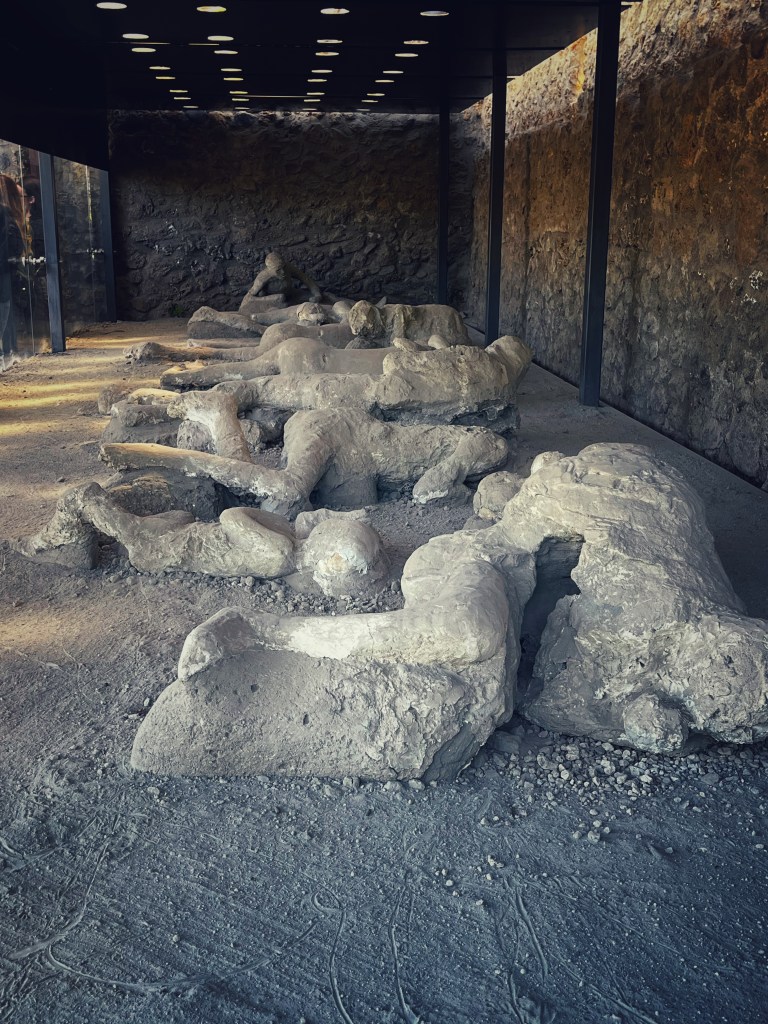
We had a map, though it looked like most of the signage was meant for the audio guide that was apparently rather unreliable based on multiple commentaries I had reviewed. So we eventually headed to the south-end to the Garden of the Fugitives where the plaster casts of several people who were buried in the gardens were excavated.
Most of the people in Pompeii died from the poisonous gases and suffocating dust from the falling pumice stone rather than being burned alive. They were then buried under mountains of ash which explains their rather intact state and slow decay. You could tell that some were crushed but others were remarkably intact. Many were hugging or in defensive postures or had simply fallen on the spot and died. Clothes and shoes remained along with jewelry and in some cases caches of jewelry and expensive artifacts were found nearby indicating some had tried to flee to the ocean with their worldly goods.
Beyond the plaster casts of the fallen were the endless ruins, flanked by spring poppies, lending an interesting contrast to the atmosphere. The wind was kicking up dust on the roads and after a while it got warm enough to peel off a layer.
Pompeii is quite a site and you could literally spend days crawling amongst some of the crumbling homes; towards the back of many homes there were gardens and the remains of what would have been fountains or ponds. In many of the main structures were fantastic renderings of daily life and art depicted on battered reliefs on the walls and ceilings.
The main commerce area is a romanesque tribute to the stately influence at the time; large in ideas and scale and here you come to understand the wealth of the city. Several of the private estates had large ornamental gardens, some of which have been reconstructed and are perfect for musing on a sunny spring day.
It was crowded but not too bad considering the popularity of the site and we found some areas I guess not worthy of the main tourist crowds down by the colosseum area, with a gorgeous avenue lined with massive cypresses and elaborate tombs. In contrast, the area butted up against a modern boulevard just beyond the wall. It was a perfect spot for a picnic amongst the ruins.
The vineyards were being tended as we walked through with Vesuvius in the backdrop as if it was just another day in paradise.
Pompeii was an idyllic city, a bit of a Garden of Eden in my estimation, boasting around 20,000 inhabitants and teaming with commerce, a grandiose commerce center reminiscent of Rome, the baths with R rated reliefs, simple and elaborate estates, beautiful vineyards and gardens, next to the sea in a temperate climate. If you think of a woman reclining on a stone bench next to a large urn of wine, eating from a bowl of grapes, under a soothing arbor surrounded by roses; this is how I imagined life back in the day. Not to say they didn’t have their issues but from what I could tell life wasn’t too bad and as we all know…it can disappear in a New York minute.
The aftermath of the cataclysm that occurred here is forever etched in the remains of morbid caricatures and ruins that satisfy our curiosity like a treasure hunt, yet are a puzzle to the mind; we try to imagine, but will always come up short on what happened on that fateful day. But it’s ok to wander amongst the ghosts, they always have interesting stories to tell.
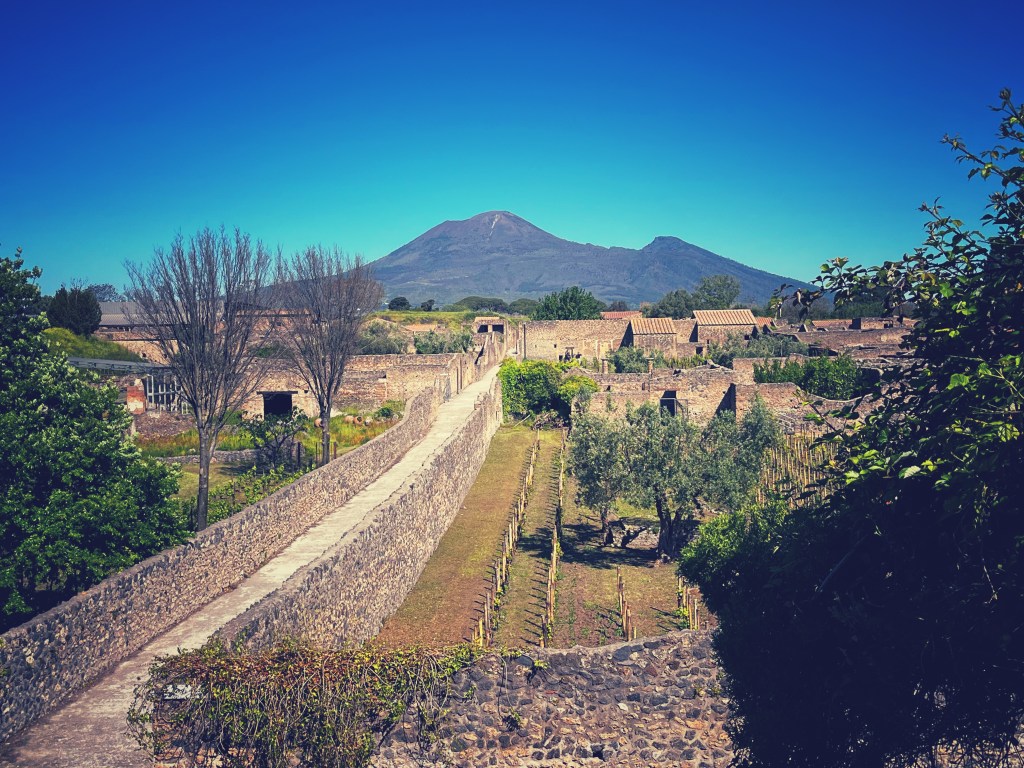
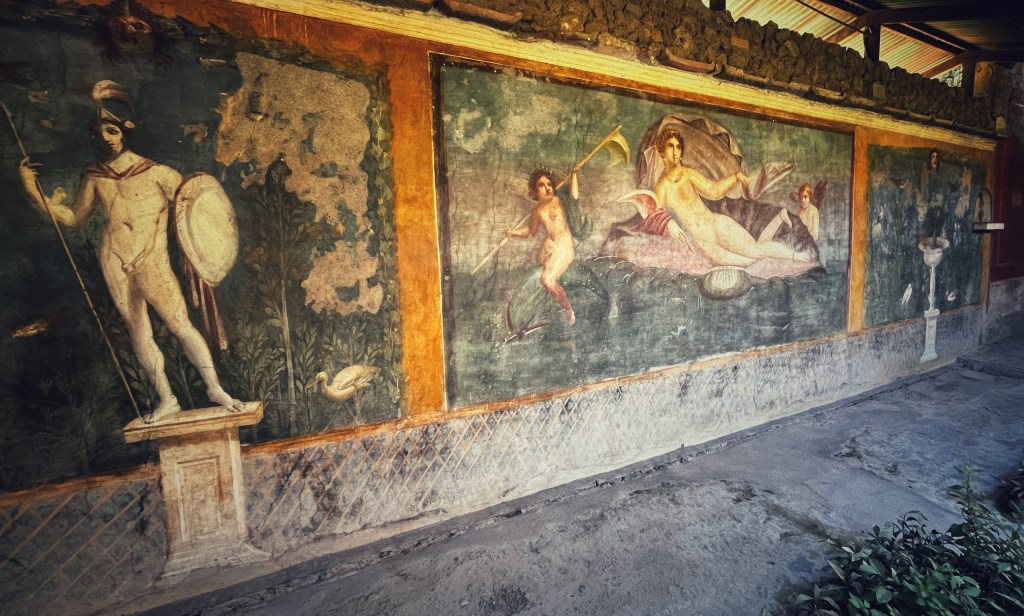
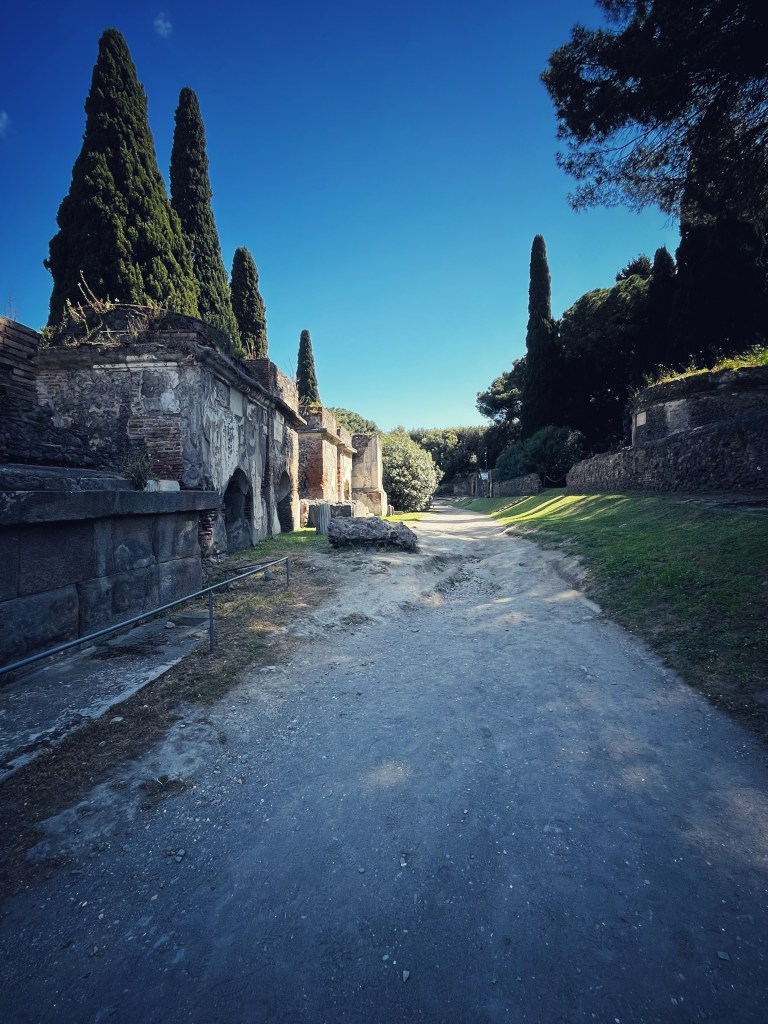
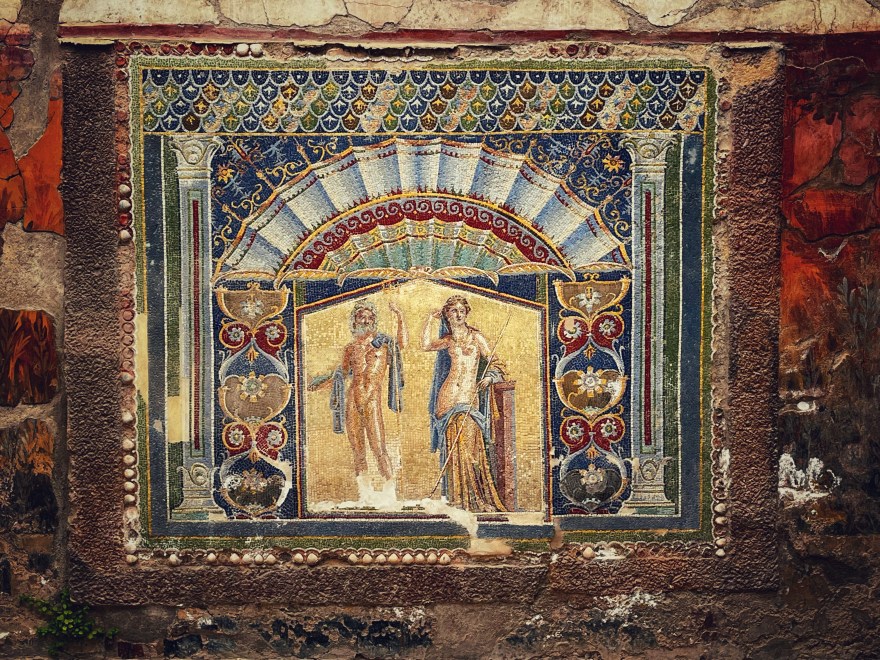
The next day we threw caution to the wind and decided to visit Herculaneum without much planning which turned out to be pretty simple; we walked right in. Herculeaneum, named after Hercules, is the smaller more intimate brethren of Pompeii, closer to Naples, originally boasting a population of 6-8000 wealthy inhabitants including freed slaves. It suffered a different sort of fate: While Pompeii was covered in ash, Herculeneum was submerged in a sort of volcanic sludge, and lots of it. It once sat directly on the seaside and when you visit you think there is a wall surrounding the city, but that’s not the case – the “wall” that now separates the boat docks from the actual sea is the almost now-petrified mud that consumed the city on that fateful day in August 79 AD. It is about 16 meters in high! Herculaneum had been forgotten over the centuries until a farmer started digging and encountered buildings. Since that time entire homes have been moved to accommodate the excavation that has been going on, seemingly, for decades.
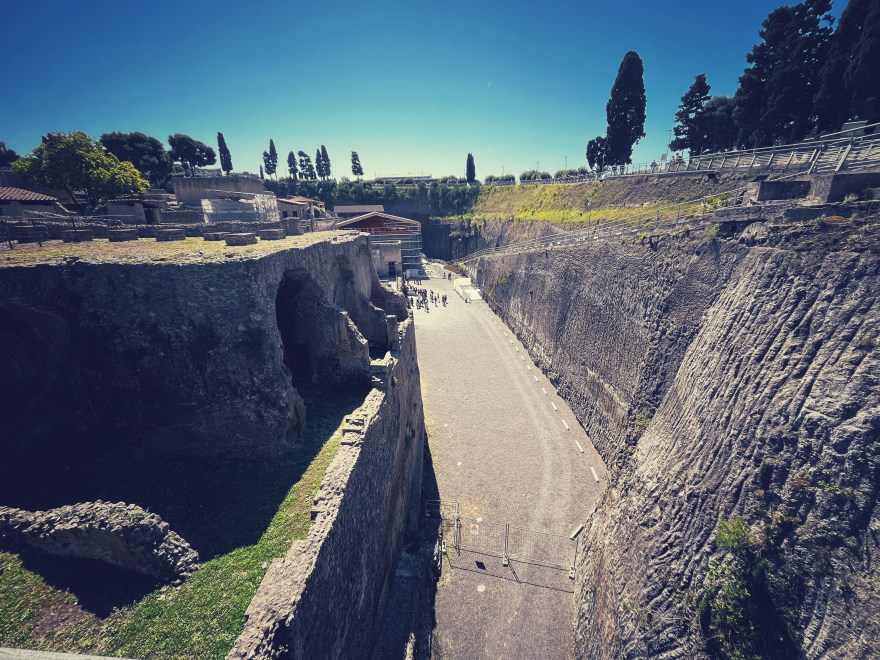
Walls of volcanic mud encased the entire city and harbor
What they found were nearly perfectly preserved mosaics and frescoes, along with a bounty of money, jewels, food vessels, utensils, surgical instruments, glass cups and art, and large deposits of skeletons encased in the boat docks; those who had waited to be rescued with all their worldly possessions by the Roman Navy that never materialized.
You can easily do Herculaneum in 2-3 hours and there is an “antiquarium” where many of the artifacts are kept with beautifully forged gold rings and earrings that had laid perfectly preserved for centuries. I did not see a single dent or scratch in the gold; they looked as pristine as though they had been forged yesterday.
The locals were big on “fast-food” and there were (like Pompeii), several tavernas scattered throughout the city. You have to think food preparation was a bit more involved back then so it was easier to just go and buy lunch at the local taverna where food was prepared from in huge terracotta pots. There were also remnants of bread ovens and with the underground aqueducts there was always a ready supply of water for food production and of course endless amphoras filled with wine – and even advertisements for different kinds of wines!
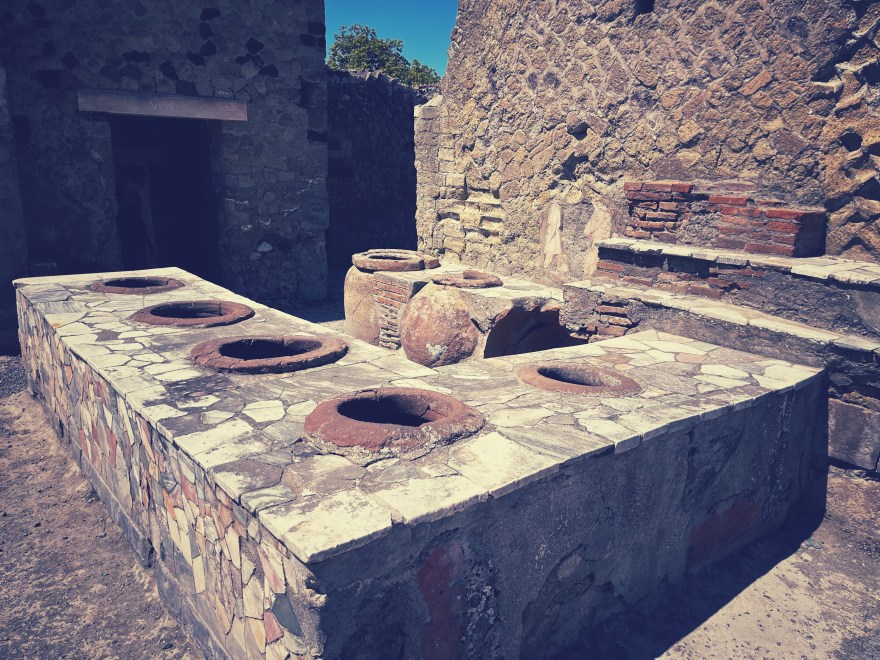
An ancient taverna
Like much in ancient Italy and especially Rome, they had plumbing, heated bath houses, fountains, ponds and even toilets supplied by vast aqueducts.
The frescoes and mosaics are better preserved here than in Pompeii and there are even second story buildings that somehow survived the onslaught.
While Vesuvius sprayed its ash and projectiles at both cities, Herculaneum got the onslaught of pyroclastic flows more so than Pompeii. While the blast of ash and pumice, crushed, poisoned and literally cooked people, I get the impression that the mud flow, like lava, simply flowed and enveloped the city at a slower pace, thus the amount of nearly intact frescoes and statues that remain entombed throughout the city.
The following day we ventured along the mountain highways to Almafi by way of Ravello; we bypassed the infamous coastal highway but suspect we would have plenty of opportunity to run the gauntlet if we chose to do so. We were greeted with a fantastic view of Mt. Vesuvius and the sprawl of civilization below.
We easily found parking in Ravello which is a charming city that lives up to the hype; its pristine piazza and quaint shops are flanked by restaurants and proved to be a bit of an art colony. It sits at a lofty height and has some of the most beautiful gardens on the coast. We visited the Infinity Garden that were for some time graced by famous movie stars during the golden era of Hollywood.
The views are quite astounding and not for the faint of heart if you are afraid of heights. It wasn’t overly crowded that day and we walked through the shaded area of the manicured rose garden, and under the wisteria arbors. It was quite pleasant and you could even sit at a lawned cafe and pass away the time in awe of the fantastic views. The temperature was perfect; neither hot nor cold and I started feeling heady taking in all the surroundings.
We made our way down to Almafi with its hair-pin turns and all was going pretty smoothly until we reached the actual coastal road; then the traffic came to a crawl and it took us nearly 45 minutes to go a couple of miles. The area was spilling over with tourists and when we reached the main street that goes through Almafi we were greeted by our host, Sergio, on his scooter. Well, then the real fun began as we were led through the main tourist street, chocked up with tourists and we had to continuously honk to make our way through the maze. It was quite the experience and I went from what could have been aggravation to actually laughing because the experience was quite insane.
Once we ran the gauntlet we arrived at the garage where we ditched the car for the week; the idea of driving around this area is not a good one and we can walk or ferry anywhere that we needed to go anyway.
Well, then Sergio grabbed our luggage and hauled it up nearly 200 vertical steps up to our BNB – Via Paradiso. But the effort was certainly worth it as we were greeted with a two-story apartment that seemed to hover over Amalfi itself with views into the sea. The apartment was recently renovated, spacious, airy with views up and down the gorge..
Anytime we went into town we knew we had to “run the gauntlet” up to our digs so we made sure we had what we needed as a simple trip back to town wasn’t in the cards!
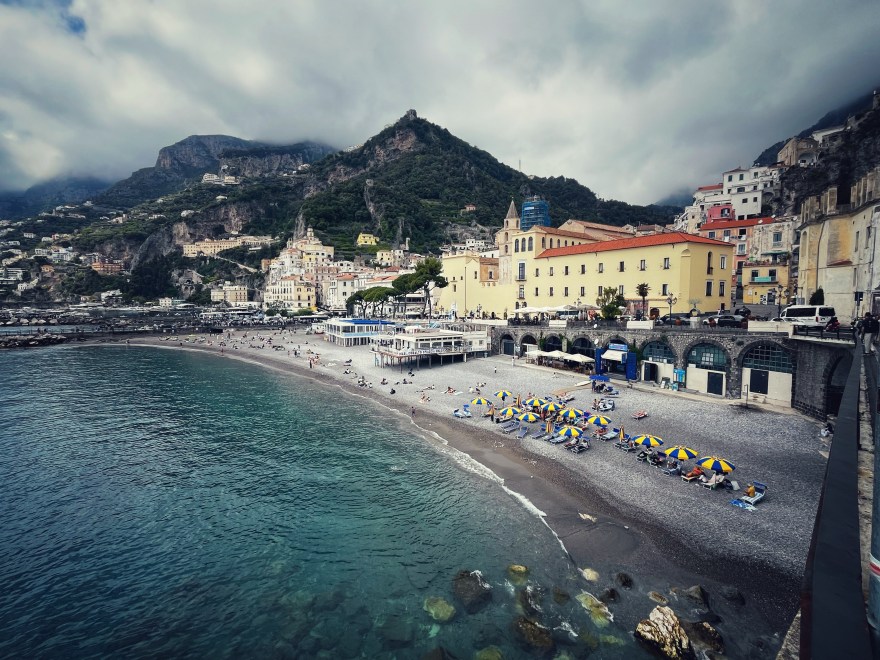
Almafi
It never ceases to amaze us how the human race manages to engineer homes in what I would consider an impossible venue; many homes seem to teeter on the edge of a granite cliff and we try to see where the roads lead to get to those lofty heights.
We certainly landed in an idyllic setting, surrounded by fresh sea air, incredible blue lagoons and coves and the constant scent of lemons wafting from the endless orchards.
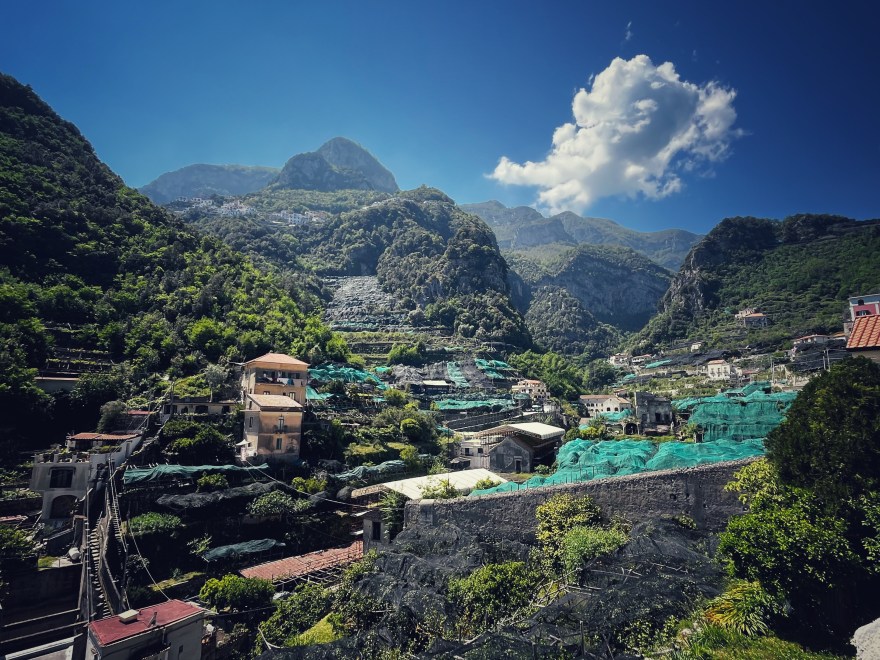
The views from the 200 step hike to our accommodation were worth the effort
On our excursions from the BNB to downtown Almafi, we ran into a caravan of donkeys coming into town carrying lemons one day and rubble from a renovation the next. Old school transportation seems quite clever, especially when you think about the fuel shortages looming all over the world due to the war in Iran.
Lemons are certainly the thing here, they permeate the air, the soaps, the liqueurs (lemoncello), the table cloths, ceramics and artwork. And these are not dainty lemons – they are about the size of an elongated orange!
We stayed local, relaxing, enjoying the cafe culture with a cappuccino, exploring the shops and the town and simply taking some time out to breathe from our ridiculously busy schedule which seems insane for a couple of “retirees.”
We took one day to venture to Positano and fell immediately in love with it, like Ravello, it has an artist vibe, with vendors along the winding avenues, then flanked by upscale fashions shops and then ceramics galore where I stumbled upon my favorite Deruta ceramics and added a vase and a couple of candlesticks to my collection. Getting these pieces from Italy guarantees authenticity which is where I got most of my collection years ago on a trip to Tuscany; I have a few pieces from Sur La Table but I do question their origin. And shipping to France is a no brainer!
We ate at a roadside bistro that looked down into the Tyrrhenian Sea and the vibrant spill of Positano and its beaches. We couldn’t have asked for better weather as it wasn’t too hot – in the high 60’s to low 70’s with a breeze.
This was one of the few times in the last couple of years that we have had the opportunity to do things, or not do things, or just bum around and we landed in quite the perfect venue for that. ❤️
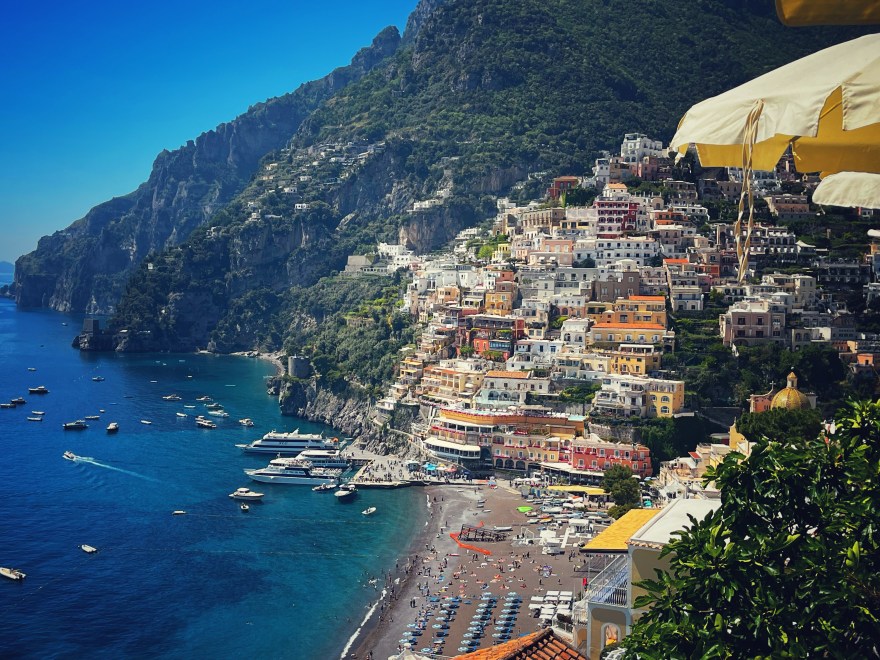
A picture perfect day in Positano
Back in Almafi, we went out for a really nice dinner at Da Gemma which is tucked into one of the back alleys so there was not so much noise from the main street, and the outdoor terrace is on an upper level so you are essentially buffered from most of the chaos.
Both of our knees were on the mend so we decided to take it a bit easier though Bob did go on a hike into the local gorge where he discovered old ruins and even the remains of an ancient aqueduct. This area is rife with hikers and we routinely passed them coming and going from our apartment.
The venues from this trip have been truly remarkable, with some site seeing buffered by a fair amount of relaxation with the sun, the scents, the sometimes comical chaos that is Italy. It was very busy and it’s not even the high season so we are thankful that we came when we did and were able to truly decompress.
Taking the time to relax, to experience the rush of the local river through the mind’s eye, though here it’s more like a gentle flow riding on the scent of lemons as you venture up into the gorge, with the eagle-eye views and the mind-bending homes perched into the cliffs.
Almafi Reel https://youtu.be/wOhH2ZUyuO0?feature=shared
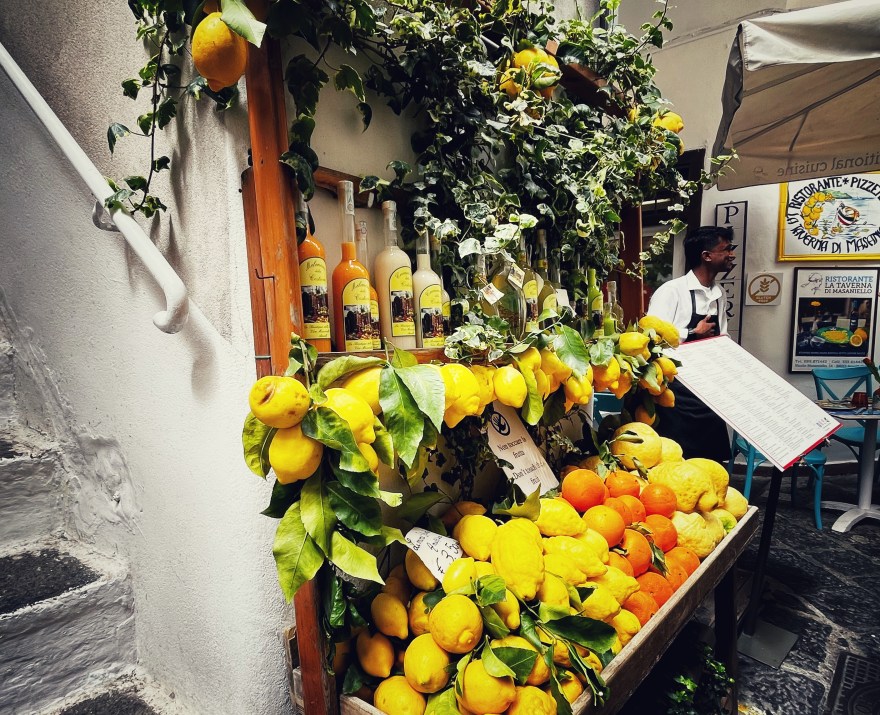
The peerless Almafi lemon
 FocalDreams